
Achilles Tendon Pain Treatment in Soho, Central London
Achilles Tendon Pain Treatment at Elevate Clinic, Central London:
Your Achilles pain rarely starts with one big injury.
Most people don’t walk into clinic saying:
“I tore my Achilles.”
They usually say:
“It started as a bit of stiffness.”
Perhaps it was the first few steps out of bed.
A slight ache after a run.
A tight feeling climbing the stairs.
Something that settled once you got moving.
Until one day…
It didn’t.
That’s the story we hear most often.
The tendon didn’t suddenly become painful.
It gradually lost the capacity to cope with the tensile load you were asking of it.
That’s where we begin.
Let’s figure out what’s actually going on.
Then we’ll build a plan that gets you back to doing what you love.
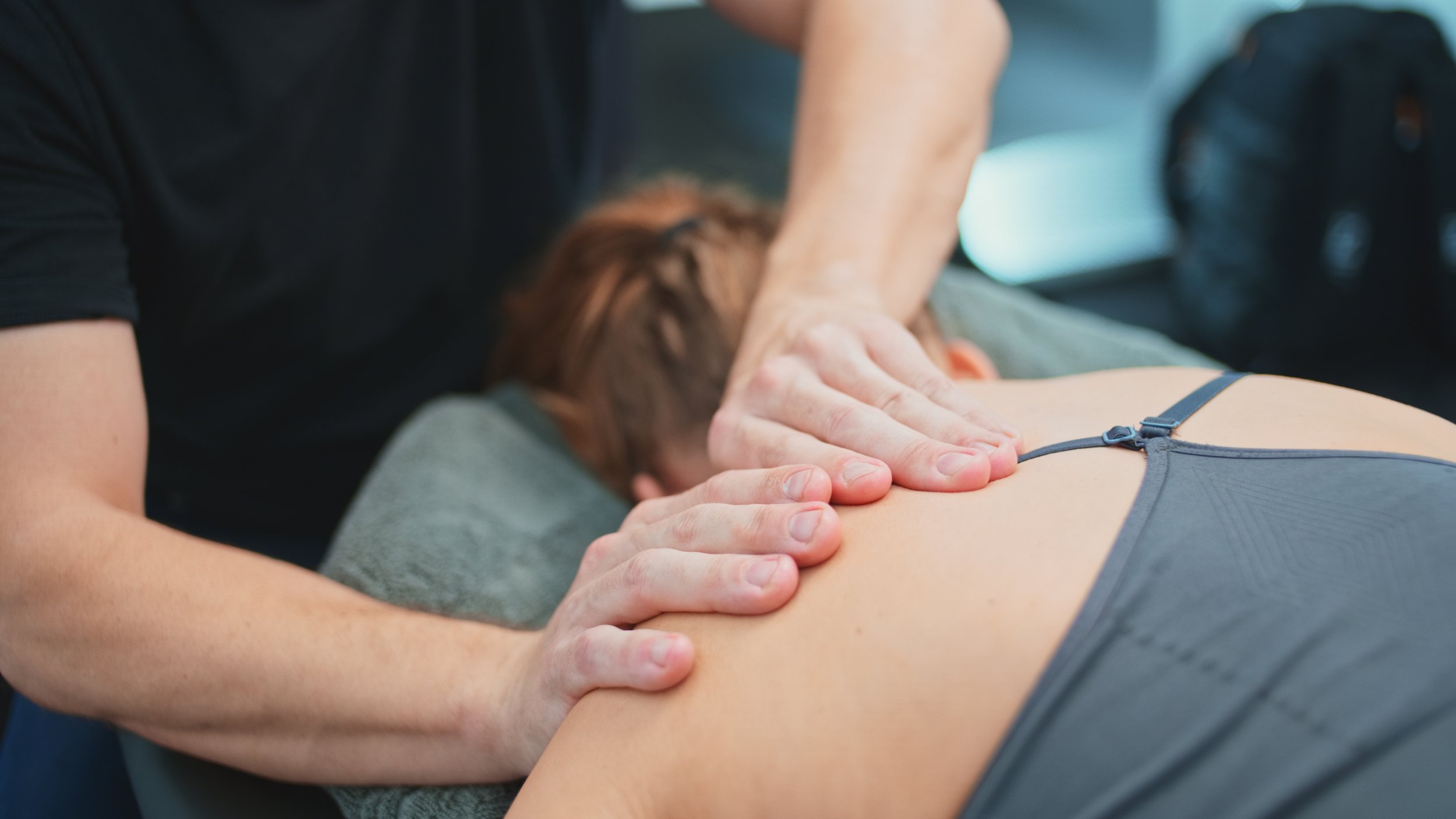
Does this sound familiar?
People with Achilles tendon pain visit us at our Soho clinic and often tell us:
My first few steps in the morning are the worst.
It eases once I’ve walked around.
It hurts after I run rather than during it.
Going upstairs is uncomfortable.
Hills make it worse.
It feels thick or swollen.
I can still train, but it complains afterwards.
It keeps coming back every few months.
Those patterns are incredibly useful.
They help us understand how irritable the tendon is and where you are in your recovery.
This is a conversation we have almost every week…
Patient:
“I thought it was just a tight calf.
I stretched it for weeks.
It always felt great afterwards…
…but later that day it came back again.”
That’s a really common story.
The tendon isn’t necessarily tight.
It’s overloaded.
Stretching may temporarily distract your nervous system from the pain, but it doesn’t always improve the tendon’s ability to tolerate load.
In some cases, particularly with mid-portion Achilles tendinopathy, too much stretching can actually introduce compressive loading at the insertion point, making things more irritable.
The question isn’t simply:
“How do we reduce today’s pain?”
It’s:
“How do we build a tendon that’s stronger next month than it is today?”
Not all Achilles pain behaves the same.
One of the first things we want to establish is where your pain is.
Is it in the middle of the tendon (mid-portion)?
Or right where the tendon attaches into the heel bone (insertional)?
Those two problems often need slightly different rehabilitation.
Insertional Achilles pain is often irritated by dorsiflexion compression against the calcaneus (heel bone).
Mid-portion tendon pain is more commonly affected by tensile force and how the tendon is loaded over time.
Understanding the difference helps us choose the right loading exercises from the beginning.
If we’re not measuring it, we’re guessing.
Every tendon tells a story.
We just need to know what to measure.
During your assessment at our Central London clinic, we’ll look at key markers:
Where your pain is located.
Morning stiffness and how long it lasts.
How your symptoms respond later that day.
How your tendon feels the following morning.
Single-leg calf strength (gastrocnemius and soleus capacity).
Heel raise endurance.
Balance and neuromuscular control.
Running or walking tolerance.
One of the most useful questions we ask isn’t:
“Did it hurt while you exercised?”
It’s:
“How did it feel three to eight hours later?”
And…
“What was it like when you got out of bed the next morning?”
Those answers tell us whether we’ve loaded the tendon appropriately.
Because rehabilitation isn’t about avoiding pain altogether.
It’s about giving your tendon enough load to stimulate adaptation without asking more than it can currently tolerate.
If we’re not measuring those responses…
We’re guessing.
Tendons adapt to what you ask of them.
One of the biggest myths about Achilles pain is that once a tendon becomes painful, it’s permanently damaged.
That’s rarely how tendons behave.
A tendon is living tissue.
It’s constantly responding to the forces you place through it.
When it’s exposed to the right amount of progressive mechanical load, it remodels.
The collagen fibres become better organised, lining up in the direction they’re needed to transmit force.
Over time, the tendon becomes stronger, more resilient and better able to tolerate the demands of running, sport and everyday life.
When it’s overloaded for too long—or not loaded enough—that remodeling process becomes less efficient, and the tendon may begin to complain.
That’s why rehabilitation isn’t about resting forever.
It’s about giving the tendon the right amount of work at the right time.
Early on, that might mean isometric exercises to help settle pain.
As things improve, we’ll gradually introduce heavier isotonic and eccentric strengthening exercises designed to encourage the tendon to adapt.
We’re not trying to avoid loading your tendon.
We’re trying to teach it how to tolerate load again.
Our aim isn’t simply to reduce today’s pain.
It’s to build a healthier, more resilient tendon that’s ready for whatever you want to ask of it.
Recovery is not judged by today’s pain.
Achilles tendons often behave differently from muscles.
It’s common to feel quite good while you’re exercising…
Only to notice the tendon becoming sore later that afternoon.
Or the next morning.
That’s why we encourage patients to look at the overall trend rather than one individual run.
Is your morning stiffness becoming shorter?
Are you recovering more quickly?
Can you walk or run further before symptoms appear?
Is the tendon settling faster after exercise?
Those are often the first signs that rehabilitation is working.
Recovery isn’t about chasing a pain-free day.
It’s about seeing steady progress over weeks.
What if you’re not improving?
Most tendons follow a predictable recovery pattern.
If yours isn’t… We’ll stop and ask why.
Have we diagnosed the right problem? Are we loading it too much? Not enough?
Is something else contributing?
Occasionally, long-standing tendons stop responding to loading alone.
In those cases, treatments such as shockwave therapy (ESWT) may have a role—not as a first choice, but as an option to stimulate healing when appropriate.
Whatever we recommend, we’ll explain why.
And if your recovery isn’t following the path we’d expect, we’ll adapt the plan rather than simply asking you to keep doing the same exercises.
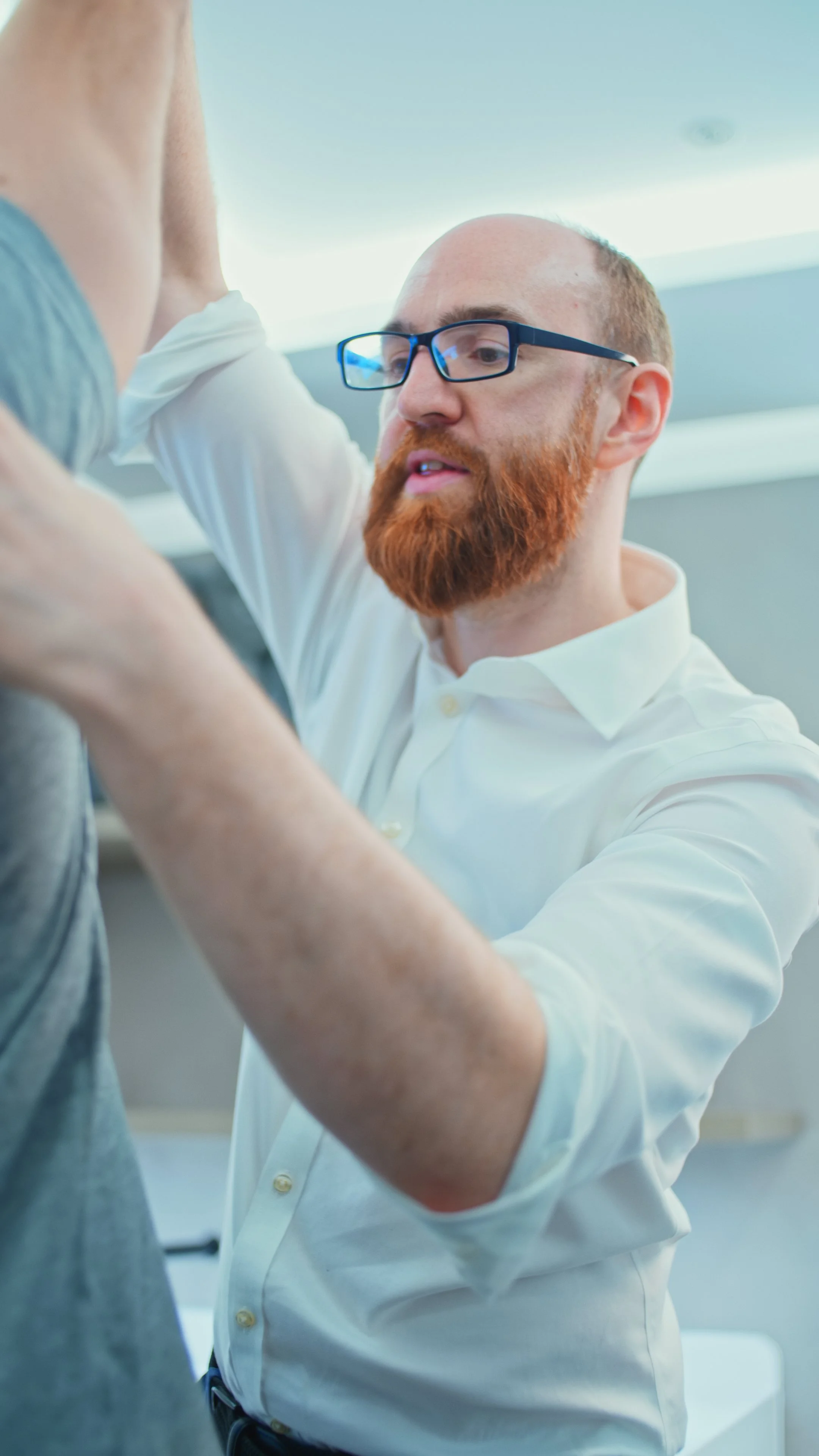
Elevate founder Jon Cairns
We’ll work through this together.
There isn’t one perfect exercise.
There isn’t one magic treatment.
The best rehabilitation comes from understanding how your tendon responds and adjusting the programme accordingly.
We’ll explain what we’re looking for, why we’re progressing your exercises and what signs tell us you’re moving in the right direction.
The goal isn’t simply to settle your Achilles pain.
It’s to build a tendon that’s capable of taking you back to running, sport and everyday life with confidence.
FAQs
Should I stop running?
Not always. Many people can continue running with appropriate modifications to training volume, pace or terrain while the tendon recovers. We’ll help you decide what’s clinically appropriate for your situation.
Why is my Achilles worse in the morning?
Morning stiffness is one of the hallmark features of Achilles tendinopathy. We use both the intensity of that stiffness and how long it lasts as useful markers of recovery.
Will stretching help?
Sometimes, but not always. The answer depends on where your tendon pain is and why it’s developed. In some cases, excessive stretching can actually increase compressive irritation at the heel attachment.
How long does Achilles tendinopathy take to recover?
That depends on how long the tendon has been irritated. Early overload injuries often recover within weeks, while long-standing tendinopathies can take several months of progressive rehabilitation. We’ll explain the timeline we expect after your assessment.
Ready to understand your Achilles pain?
Whether you’re training for your next marathon, returning to football or simply want to walk without pain, our goal is to understand why your Achilles has become overloaded, measure your progress and rebuild the tendon’s capacity step by step.
Our clinic is based at UNTIL, 111 Charing Cross Road, Soho — a short walk from Tottenham Court Road Station.
Let’s figure out what’s actually going on.
Then let’s get you back to doing what you love.
Whether you’re an athlete, a busy professional, or someone looking to relieve tension and improve mobility, our clinic offers a unique combination of expertise, care, and the facilities to support your goals. Book a session today and experience the difference for yourself!