
Tennis and Golfer Elbow Treatment in Soho, Central London
Tennis and Golfer Elbow treatment at Elevate Clinic, Central London:
Despite the names, you don’t have to play tennis or golf to get tennis elbow.
In fact…
Most people we see with tennis or golfer’s elbow have never picked up a racket.
One of the first things we explain is this:
It’s usually a gripping injury.
Whether that’s gripping a tennis racket, lifting heavy weights, carrying tools, climbing, doing CrossFit, playing padel or simply changing the way you train, the common theme is often the same.
Your forearm has been asked to grip more than it currently has the capacity to tolerate.
That’s where we begin.
Let’s figure out what’s actually going on.
Then we’ll build a plan that gets you back to doing what you love.
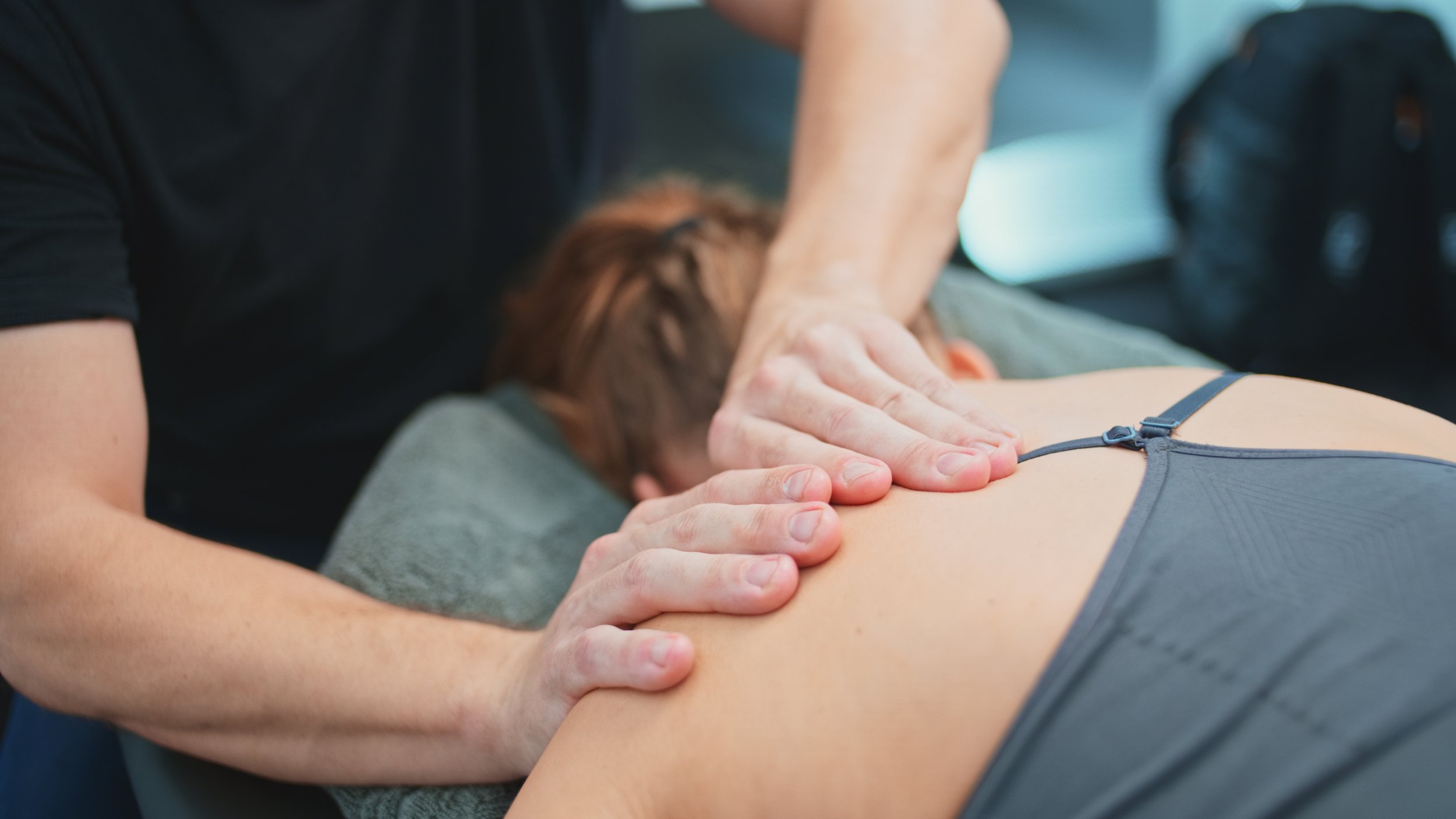
Does this sound like you?
People with tennis or golfer’s elbow visit us at our Soho clinic and often tell us:
It hurts when I grip things.
Opening jars has become painful.
Lifting a kettle hurts.
Pull-ups suddenly became uncomfortable.
Deadlifting aggravates it.
Tennis, golf or padel have become painful.
Shaking someone’s hand hurts.
The pain has slowly crept up over weeks.
Stretching it feels good… but only for a few minutes.
That last one is particularly common.
And it’s often one of the clues that we’re dealing with tendon pain.
This is a conversation we have almost every week…
Patient:
“I thought I’d just overdone it at the gym.
I kept training through it because it wasn’t that bad.
Now even picking up my coffee hurts.”
Rather than looking only at your elbow, we usually ask a different question.
What’s changed?
Have you increased your training?
Changed your gym?
Started lifting heavier?
Started playing tennis or padel more often?
Have you changed your grip?
Started climbing?
Been doing more DIY?
Almost always, there’s a story.
The tendon didn’t suddenly fail.
It slowly became overloaded.
Understanding that overload is the key to helping it recover.
Tennis elbow and golfer’s elbow aren’t the same—but they’re treated using the same principles.
Tennis elbow (lateral epicondylalgia) affects the tendons on the outside of the elbow.
Golfer’s elbow (medial epicondylalgia) affects the tendons on the inside.
Although they’re different tendons, they often behave very similarly.
One thing that’s particularly important is understanding where your pain is.
Is it directly on the bony attachment?
Or is it slightly further down the tendon?
That helps us understand whether compression, overload or a combination of both may be contributing to your symptoms.
Those details influence how we build your rehabilitation programme.
If we’re not measuring it, we’re guessing.
With elbow tendon pain, we’re trying to understand two things.
How irritable is the tendon?
And how much load can it currently tolerate?
During your assessment at our Central London clinic, we’ll look at things like:
Grip strength.
Pain during gripping.
Tendon tenderness.
Wrist and forearm strength.
Functional tasks.
Whether your symptoms behave like an acute overload or a longer-standing tendinopathy.
Grip strength is particularly useful because it gives us an objective measure we can track throughout your rehabilitation using specialised tools.
As your strength improves and your pain reduces, we know your tendon is becoming more capable—not simply less painful.
Because if we’re not measuring your progress…
We’re guessing.
Treatment isn’t about stretching it.
One of the most common things we hear is:
“I’ve been stretching it loads.”
Unfortunately, that isn’t always helpful.
Many mid-portion tendon problems actually become more irritated by repeated stretching.
Instead, we focus on progressively rebuilding the tendon’s capacity.
Early on, that may involve isometric exercises to help reduce pain.
As the tendon settles, we gradually increase loading with slow, controlled strengthening exercises.
Later, rehabilitation becomes much more specific.
If you’re returning to tennis, we prepare you for repeated racket sports.
If you’re a lifter, we’ll rebuild your grip strength for deadlifts and pull-ups.
If you’re climbing, we’ll prepare the tendon for the demands of climbing again.
The rehabilitation should match the life you’re returning to.
Recovery follows a pattern.
One thing we always explain is that tendons often behave differently from muscles.
They frequently feel better during exercise.
Then complain several hours later.
That’s why we don’t judge rehabilitation purely on how you feel while you’re exercising.
Instead, we look at how your tendon behaves later that day and the following morning.
If you’re flaring up three to eight hours after loading, that’s valuable information.
It tells us your tendon isn’t quite ready for that amount of work yet.
Those responses help us fine-tune your rehabilitation rather than simply pushing through.
We will work through this together.
There are lots of ways to manage tendon pain.
Hands-on treatment, exercise, load modification, taping, bracing, changing technique.
Our role is to explain why we’re recommending each stage and adapt the plan based on how your tendon responds.
Sometimes we’ll encourage you to keep training.
Sometimes we’ll temporarily modify your programme.
Those decisions are made together, based on your goals and how your body is responding.
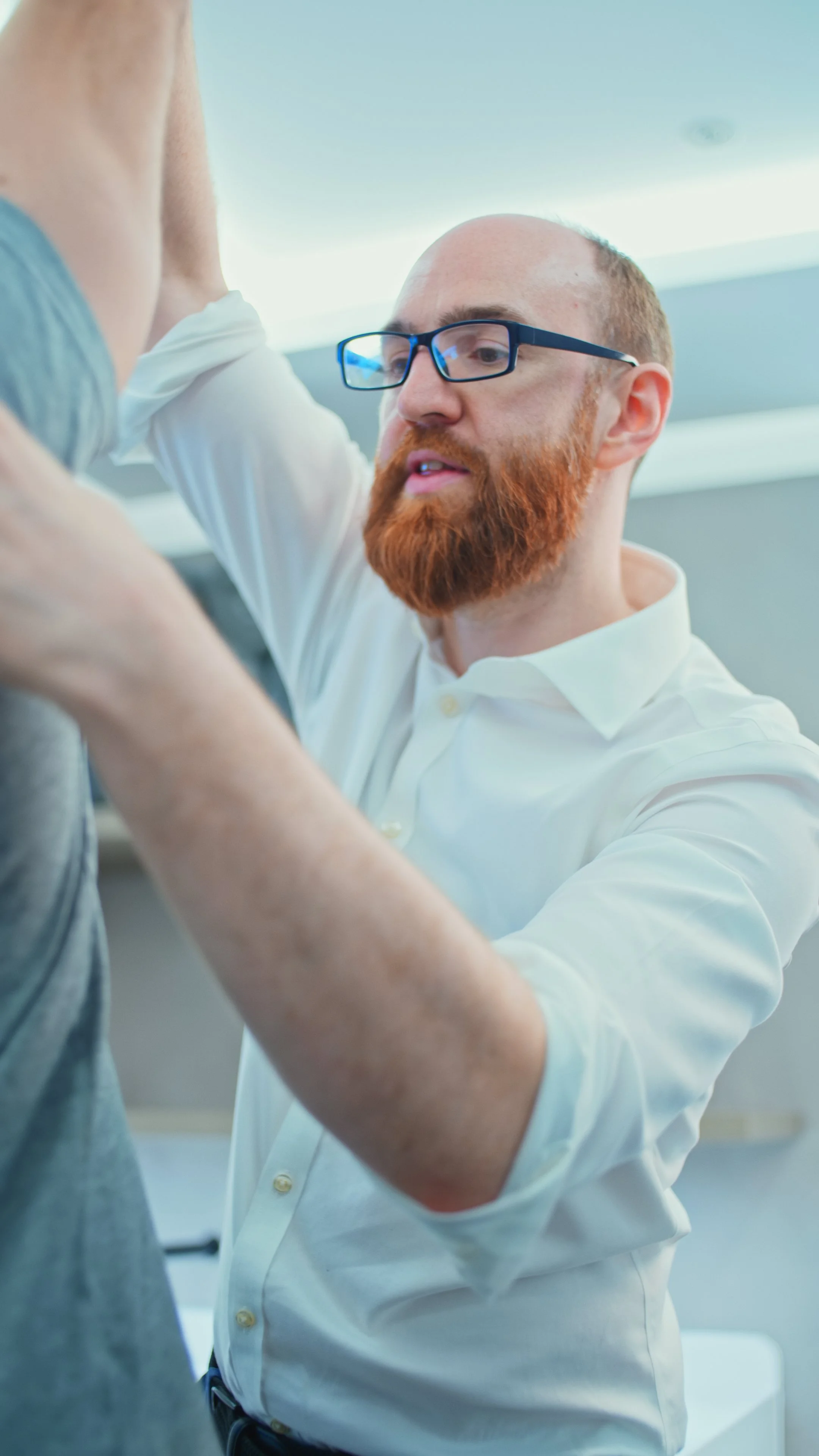
Elevate founder Jon Cairns
FAQs
Should I stop going to the gym?
Usually not. Most people benefit from modifying exercises rather than stopping altogether. We’ll help you keep training while allowing the tendon to recover.
Why does stretching feel good if it isn’t helping?
Stretching can temporarily reduce pain, but in some tendon problems it doesn’t improve the underlying issue and may even increase irritation later.
Will a strap help?
Sometimes, yes. A counterforce strap or elbow brace can reduce load through the tendon during activities and may help manage symptoms while you’re rebuilding strength.
How long does tennis elbow take to recover?
That depends on how long it’s been there. Early overload injuries often recover within weeks, whereas long-standing tendinopathies can take several months of progressive rehabilitation.
Ready to understand why your elbows keep hurting?
Whether your symptoms started on the tennis court, in the gym, on a climbing wall or while working with your hands, our goal is always the same.
Our clinic is based at UNTIL, 111 Charing Cross Road, Soho — a short walk from Tottenham Court Road Station.
Let’s figure out what’s actually going on.
Then let’s get you back to doing what you love.
Whether you’re an athlete, a busy professional, or someone looking to relieve tension and improve mobility, our clinic offers a unique combination of expertise, care, and the facilities to support your goals. Book a session today and experience the difference for yourself!